
Following cybersecurity risks and the U.S. Commerce Department’s export-control directive, the world’s most capable publicly available AI model was taken offline for 19 days this June. Fable 5 (from Anthropic, the makers of Claude) has since returned alongside questions left unanswered, and while we anticipated the re-release, precedent is stickier.
This report is aimed at helping American investors make sense of what the episode means for the AI adoption timeline, the valuations built upon it, and why diversification across the entire AI value chain matters.
Through our Needs, Means, & Seams framework, we examine what this episode means for the AI adoption timeline, the valuations built upon it, and why diversification across the entire AI value chain matters.
The market has spent two years pricing the pace of AI adoption. Considerably less attention has been directed toward the possibility that policy risk could complicate the frontier of innovation overnight, for reasons investors aren’t privy to.
| Date | Event |
|---|---|
| June 9, 2026 | Fable 5 released to the public (source: Anthropic) |
| June 12, 2026 | Export-control directive issued (source: Mayer Brown) |
| June 12, 2026 | Fable 5 shelved globally (source: Anthropic) |
| June 26, 2026 | GPT-5.6 previewed for select partners (source: OpenAI) |
| June 30, 2026 | Export controls withdrawn (source: Reuters) |
| July 1, 2026 | Fable 5 access restored worldwide (source: Anthropic) |
Fable 5 sits in Anthropic’s Mythos class, a tier above its previous top tier, “Opus.” An export-control directive is a government order restricting who may access certain technology, typically to keep sensitive capabilities from reaching foreign parties.
It is worth separating two frictions this episode revealed, because they operate on distinct timelines and touch portfolios differently.
The first is an adoption bottleneck. A business considering layering AI into operational workflows must now weigh the possibility—however remote—that it could be de-platformed. This appears to be a natural byproduct of what seems to be a U.S. pivot toward national-security framing over innovation-first thinking. Thorough vendor contract review and contingency plans against the sudden loss of a business-critical model would be a prudent first step, but prudence has a cost: contingency planning, redundant architecture, and slower procurement all lengthen the time between a model’s release and its productive, revenue-generating use.
The second is a trickle-down bottleneck: the question of whether, and when, AI’s efficiency gains reach the broader market with measurable impact. Much of the current AI valuation premium rests on the promise that they will. Delays in enterprise adoption may postpone the earnings evidence that the rest of the index is expected to provide.
If the shutdown were a one-off, it might be able to skate past scrutiny. On June 26—while Fable 5 remained dark—OpenAI previewed its GPT-5.6 family (Sol, Terra, and Luna) to a small group of trusted partners at the U.S. government’s request. Notably, the move was a voluntary step taken within the review window of a recent executive order, not an export shutdown.
Most firms are users, not collaborators, of leading AI. This “trusted partner” group could confer a durable commercial edge on those partners, but access windows so far have been measured in days and weeks, not quarters. The point remains that tiered, authorization-based access to frontier capability is beginning to look like a structural feature of this market rather than an isolated event, and structural features eventually get priced in.
AI-related valuations embed assumptions about future earnings growth well beyond the technology sector. Apollo has observed at the end of June that there is, as yet, little evidence of margins rising outside tech; implementation is near-immediate in software but slow in capital-intensive, regulated industries, and a mismatch between front-loaded valuations and a slower cashflow reality creates repricing risk.
If the return on investment (ROI) takes longer than the market expects—and if policy risk, which is inherently harder to forecast than an energy or compute constraint, now rests atop the physical ones—then the timing risk embedded in those valuations may be underappreciated.
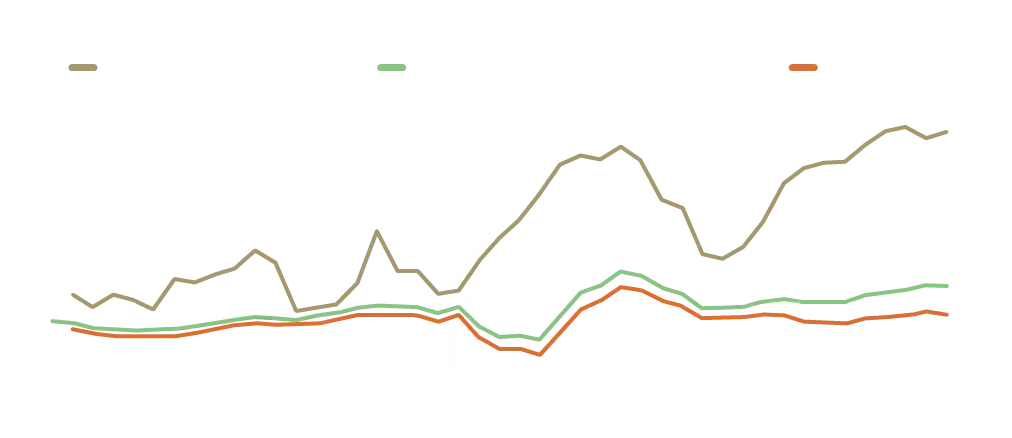
Opinions vary. Morgan Stanley’s 2026 outlook expects roughly US$3 trillion of AI infrastructure investment
through 2028, with more than 80% of it still ahead. Only about 21% of S&P 500 companies cited measurable AI benefits, and those that did saw cashflow margins expand at roughly twice the rate of peers. Opportunity realization, then, is a question linked to adoption timing.
Our framework examines how capital allocation is shaped by structural demand, the resources available to meet it, and the fault lines between them.
Needs. Every participant in the AI cycle needs to see something different for the cycle to keep turning. Hyperscalers need adoption. The companies adopting need reliability and demonstrable use cases. Investors need monetization and earnings sufficient to justify existing valuations. Governments need security and sovereignty. And the technology itself needs energy, memory, transmission, and the rest of the physical buildout.
Means. Each participant holds something another needs, and the engine runs smoothly when gears meet without friction. Investors command sentiment, fueling valuations that incentivize immense capital expenditures. Hyperscalers hold the capital to create the technology that companies draw on for efficiencies. Those businesses supply real-world demand and adoption budgets, the uptake that converts capital expenditure into monetization. Government policy juggles model access with security and sovereignty assurances that underpin trust in the system. The buildout layer mobilizes the physical inputs required to scale the technology. In concert, these can move efficiencies across the market and broaden AI’s benefits well beyond the hyperscalers; out of concert, the engine may persist with a stutter.
Seams. These are not competing interests squaring off against each other; world-shaping innovation is just rarely coordinated flawlessly. Even when the frictions were purely physical—energy, compute, memory—that alignment was bound to take time. Policy decisions surrounding access introduce an additional, less predictable dimension compared to infrastructure, which governments are directly participating in through public-private partnerships.
The disruption resolved in under three weeks. Like us, UBS has expressed low conviction that such restrictions would persist. Policy risk should be treated as a variable to monitor rather than a reason to retreat entirely. Sentiment, as we have often noted, can recover well ahead of fundamentals.
It’s worth bearing in mind that a friction landing on every market participant simultaneously is not necessarily a relative disadvantage to any one of them.
All of that is true, and none of it dissolves the structural point. What outlasts this episode is not the specter of downtime but the demonstrated fact that the latest innovations now pass through a government checkpoint whose criteria remain black-boxed. Enterprises plan around demonstrated facts. We are not alone in this view, and we expect greater clarity to emerge over time.
The lesson generalizes beyond any one company or country. Governments are taking “AI sovereignty” more seriously, which raises the cost—for nations and enterprises alike—of concentrating dependence in any single national supplier.
European governments, including France, Germany, and Spain, have reportedly been reassessing their reliance on certain U.S. providers. The Tony Blair Institute frames the balance well: sovereignty is not self-sufficiency, and failing to access the best systems is itself a risk.
“What sets states apart in the age of AI is not the lack of interdependence but their ability to manage it.”
— Tony Blair Institute for Global Change, Sovereignty in the Age of AI
Advanced economies are pursuing resilience through fallback capacity and governance credibility; capital-rich states through direct ownership or creation. Either way, the direction of travel favors redundancy over concentration—which is to say, it favors diversification.
From a fable untold to one briefly on hold, this 19-day blip did not break the AI megatrend, and nothing in this report should suggest otherwise. The lingering impact could delay adoption at the margin, extend the ROI runway, and, at the very least, make the road ahead bumpier than an unbroken march higher. That much is a reasonable, unremarkable conclusion.
What it does not do is tell us which layer will bear that cost, or for how long. That remains an uncertainty that diversification is built for, not a reason to guess at it. Through Fulcrum’s direct indexing, partnered advisors have the freedom to make the choices that suit each client’s needs and manage risk-appropriate portfolios at scale. For some, that translates to stricter selectivity. For others, it means spreading investments more evenly across the entire value-creation chain: the pioneering labs, the hyperscalers, the buildout layer of industrials, infrastructure, and energy, and the businesses demonstrating capacity to adopt AI well.
Each bottleneck in that chain is, in the end, an addressable need—and an addressable need is an investable opportunity. That is the case for staying invested through episodes like this one, not despite them.